

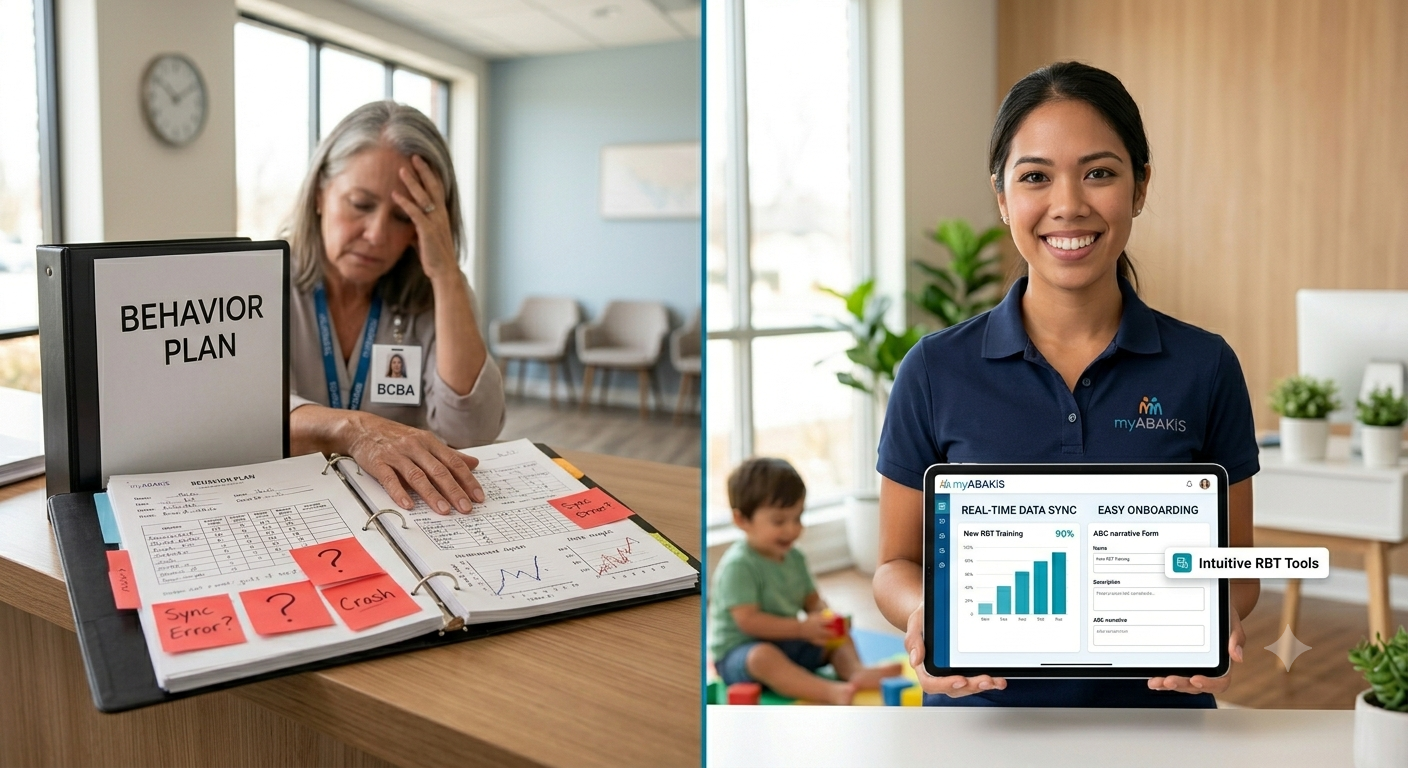
Every ABA clinic owner knows the sinking feeling of receiving a resignation text from a promising new Registered Behavior Technician (RBT). You spent weeks recruiting them, invested valuable supervisor hours onboarding them, and just as they began building real rapport with their caseload, they walked out the door. While clinic directors naturally look at supervisor support, burnout, or hourly pay when trying to reduce staff turnover, they frequently overlook a massive culprit hiding right on their team’s tablets: a clunky, over-engineered data platform. Finding the right ABA software for small clinics isn’t just an administrative choice; it is a critical staff retention strategy.
If your data collection platform is slow, crash-prone, or requires a three-day training seminar just to navigate, it is actively driving your frontline staff away. Here is exactly how an unintuitive interface causes your new hires to throw in the towel—and why switching to a user-friendly ABA data collection tool is essential for ABA clinic efficiency.
An RBT’s primary focus should be on the child—managing challenging behaviors in real time and delivering precise reinforcement. When a platform lacks dedicated, simple RBT tools, it forces the technician to look away from the client to navigate endless nested menus just to log a single behavior drop.
Juggling a timer, clicking behaviors, keeping a child safe during a tantrum, and fighting a lagging interface creates severe cognitive fatigue. When data tools feel like a burden rather than a help, RBTs feel less like therapists and more like data-entry clerks. They inevitably leave for clinics that utilize the best ABA software for small clinics—tools that allow them to focus on clinical delivery rather than technical troubleshooting.
For a growing practice, a major operational leak is the time and money spent training new staff on enterprise-grade software. Traditional platforms are notoriously complex. When a new hire is thrown into a confusing system, they experience intense anxiety about clicking the wrong button and ruining a client’s historical data trends.
If your software requires hours of technical hand-holding before a technician feels confident, it creates early job dissatisfaction. Transitioning to a streamlined ABA software for small clinics ensures that new hires can independently and accurately run a session on day one.
Consider the experience of an RBT running an in-home session. They are trying to log Antecedent-Behavior-Consequence (ABC) data while a parent watches their every move. If the app freezes, spins, or logs them out entirely, the technician faces a stressful dilemma: stop the clinical flow to troubleshoot the app, or rely on memory to log data hours later, which drastically reduces accuracy. No professional wants to look incompetent in front of a client’s family because their agency’s software refuses to function smoothly.
The best ABA software for small clinics should serve your frontline staff, not dominate their attention.
Stop losing your best frontline talent to administrative exhaustion. Maximize your ABA clinic efficiency and protect your clinical team by choosing tools built for human beings.
Ready to simplify your data and stabilize your team?
Request a Demo of myABAKiS Today and see how our streamlined ABA software for small clinics eliminates the daily headaches that cause RBT burnout.
