

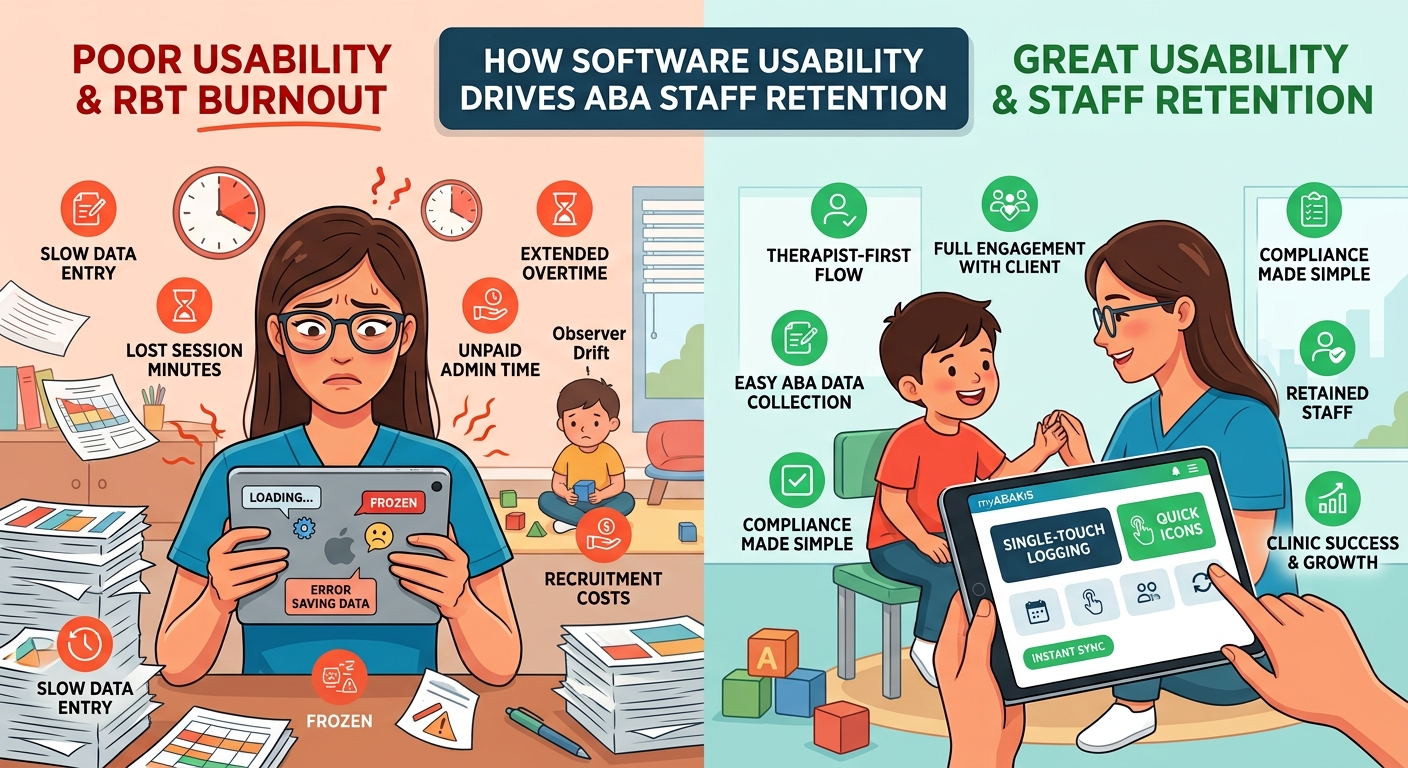
Registered Behavior Technicians (RBTs) and frontline therapists drive the daily client progress that defines successful Applied Behavior Analysis (ABA) practices. Yet, practice owners across North America consistently rank RBT turnover ABA challenges among their primary operational bottlenecks. While low wages and physical exhaustion receive most of the blame, clinical leaders frequently underestimate a major contributor to therapist burnout: poor ABA software usability.
When data collection tools are slow, unintuitive, or prone to lagging, frontline staff spend critical session minutes managing screens instead of engaging with clients. Over time, this daily administrative friction exhausts therapists, driving them out the door and saddling clinic directors with staggering recruitment and onboarding expenses.
Losing a therapist involves financial losses that extend far beyond replacing an employee on your roster. High RBT turnover ABA metrics destabilize your practice across four core operational areas:
The Retention Cascade Impact
- Direct Financial Losses: Recruitment, background checks, job postings, and non-billable training hours.
- BCBA Administrative Overhead: Diversion of billable supervision hours toward re-training incoming staff on basic clinic software.
- Stalled Client Progress: Behavioral regression, interrupted rapport, and delayed skill acquisition for autistic children.
- Regulatory Compliance Exposure: Increased risk of documentation gaps and session logging errors under standard regulatory audits.
During an intensive session, an RBT must manage behavioral momentum, deliver prompts, reinforce target responses, and record continuous data simultaneously. Poor ABA software usability injects constant cognitive strain into this environment, which can make adhering to professional standards like the Behavior Analyst Certification Board (BACB) RBT Ethics Code unnecessarily difficult.
When logging a simple frequency or duration count requires tapping through sub-menus or waiting for screens to reload, the therapist’s focus shifts from the client to the screen. This delay creates behavioral opportunities for the client to engage in off-task behavior or escape demands.
When data tools are frustrating, therapists delay entering session notes until after hours or resort to inconsistent shortcuts. Logging notes hours after a session introduces recall bias, weakens Interobserver Agreement (IOA), and creates data fidelity issues during clinical reviews.
Forcing RBTs to wrestle with non-intuitive software to write simple daily session notes creates burnout. When administrative friction makes direct care feel overwhelming, therapists leave for practices offering simpler, modern systems.
Fixing RBT turnover ABA issues requires removing technology barriers so your clinical team can focus on what they do best: helping children succeed.
Therapist-First Workflow
- 1. Single-Touch Data Logging: Record trial responses, prompt levels, and behaviors instantly without breaking engagement with the client.
- 2. Instant Offline Sync: Prevent data loss and software lag during community or in-home visits.
- 3. Standardized Session Notes: Complete compliant, audit-ready clinical notes within the billable session window.
The best ABA clinic data management systems are built with a practitioner-first focus, eliminating unnecessary software friction so your clinical team can thrive.
By prioritizing systems designed for daily usability, you protect your therapy team from burnout, lower recruitment costs, and maintain clinical care standards across your practice.
Empower your clinical team with tools built for simplicity and long-term therapist retention. Request a Demo with My ABAKiS Today to see how effortless data collection can be.
